

Remembrance Day NZ Display: Tasteful Shopfront Content
Every year on 11 November, New Zealand shopfronts face a small but visible decision: say nothing, post a poppy, or keep running the same promotions on screens that have been looping sales all week. For a business with a window facing the street, that choice is seen by everyone who walks past during the morning observance. This guide explains how to handle Remembrance Day NZ display content with restraint, what to avoid, and how to schedule commemorative material on digital screens so it reads as respect rather than marketing. Wednesday 11 November 2026 is not a public holiday, so most of your customers will be going about their normal day, which makes the window one of the few places where you can get the tone exactly right.
Table of Contents
- Quick Takeaways
- The History Behind 11 November
- Tasteful Versus Tacky: Where the Line Sits
- Poppy Imagery and Wording
- Timing Your Content Around 11am
- Choosing Your Remembrance Day NZ Display Format
- Local Services and Community Expectations
- Scheduling Commemorative Content on Digital Screens
- Common Mistakes That Cost Goodwill
- Frequently Asked Questions
- References
Quick Takeaways
| Key Insight | Explanation |
|---|---|
| Keep the message about remembrance, not sales | Drop discount badges, “Remembrance Sale” headers and countdown timers on 11 November. Move any offer to another date. |
| Plan for the 11am minute of silence | Switch digital screens to a still, plain slide for that minute. Remove motion, audio and promotional content. |
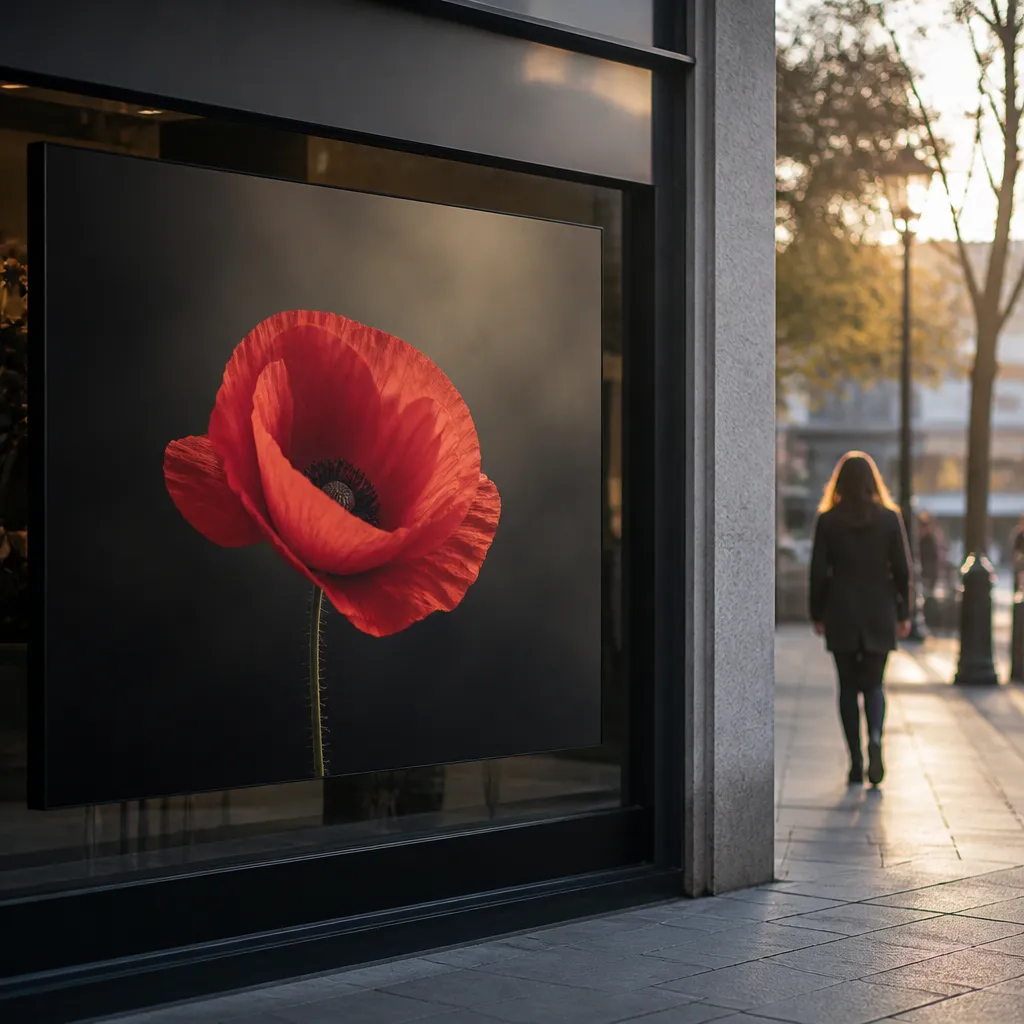
| Use one poppy, not a collage | A single focal point is readable from the footpath. Busy paper displays often are not. |
| Avoid graphic war imagery | Use only archival images whose source and rights you can confirm, and that you can explain in one sentence. |
| Load content days early | Upload and test the remembrance playlist before the morning of 11 November, not during it. |
| Set a clear end time | Return the screen to normal content when the observance ends so the slide does not linger for weeks. |
| Check local services first | Confirm service times and any road closures with councils and local returned services associations before you publish. |
The History Behind 11 November
On the 11th day of the 11th month in 1918, the guns fell silent after four years of continuous war, and a peace settlement was secured by the armies that had been fighting. That moment is the reason the minute of silence still anchors the observance. Most people know the date, but fewer know the full arc, and that background is useful when you have only a few lines of copy to work with.
From Armistice Day to Remembrance Day
The day was originally known as Armistice Day. It was later renamed Remembrance Day after the Second World War, which widened its focus from one ending to everyone lost across those conflicts. That shift matters for your wording. “Remembrance” invites people to think about the dead and wounded across generations, not only a single historic event.
In practice, avoid “Armistice” in customer-facing copy unless you have a specific reason. Most of your audience will recognise Remembrance Day immediately, and the older term can read like a history lesson rather than a shared moment of respect.
Why the history changes your audience
Your window will be read by people with very different connections to the day. Some have a grandparent or great-grandparent who served. Others walk past a local memorial every morning, or have children bringing home family history projects, a common way educators have approached the subject. Parents and children may already be thinking about the topic as they pass your shop.
That means your content should assume a reader who takes the subject personally. Copy that feels like a retail campaign will land badly with exactly the people you most want to reach.
Tasteful Versus Tacky: Where the Line Sits
Remembrance content goes wrong in two directions. The first is obvious: graphic war imagery, sensational photographs, or anything that treats loss as entertainment. The second is quieter and more common: a shopfront that turns the day into a décor theme, with cut-out soldiers, glitter poppies and a sale banner underneath. Both reduce the moment to a visual gimmick.
Imagery that crosses the line
Avoid battlefield scenes, bloodied uniforms and images of identifiable casualties. Archival photographs can be powerful, but only if you know their source, hold the rights to use them, and can explain why they are there. If you cannot caption the image accurately in one sentence, it does not belong in your window.
Be careful with imagery borrowed from unrelated conflicts or from other traditions. A New Zealand audience will notice a mismatch quickly, and a wrong detail on a screen at street level will be photographed and shared.
Commercial messaging on the day
The clearest rule we give clients is simple: no promotions on 11 November itself. Discount badges and countdown timers cheapen the message even when the intent is good. If you want to run an offer, move it to another date and keep the window clean for the day.
Your brand can stay present in a restrained way, such as a small logo in the corner of an otherwise plain slide. The test is whether the slide would still make sense with the logo removed.
On a day built around quiet, the most respectful window is usually the one that says the least.
Poppy Imagery and Wording
The red poppy is the most recognised symbol of remembrance, and it is the first thing most businesses reach for. It works well when it is used once, clearly and with space around it. Visual merchandising guidance often points out that passersby may give a window only a few seconds, so one strong focal point will always beat a busy collage.
Using the poppy well
A single poppy, printed large on premium paper or shown as a clean graphic on a screen, communicates more than a wall of paper flowers. Place it at eye level, centred or to one side, and leave the background uncluttered. Online inspiration for remembrance window displays leans heavily on poppy collages, and many of them would be hard to read from the footpath.
Keep the palette controlled. Deep red, black, white and a neutral backdrop look considered. Adding several bright colours tends to turn the display into party decoration.
Wording that reads as sincere
Short wording works best, such as “Lest we forget”, “Remembering those who served”, or a simple date line. Avoid clever slogans and do not rewrite traditional phrasing into something witty. If you are unsure, use fewer words.
Check spelling and capitalisation with the same care you would give a formal notice. A typo on a remembrance message gets noticed faster than a typo on a sale poster, and it is harder to forgive.
Pro tip: Have one person read your window from the footpath, at normal walking pace, before you go live. If they cannot take in the main line in about three seconds, the text is too small or the layout is too busy.
Timing Your Content Around 11am
The minute of silence defines how your window should behave on 11 November. The traditional observance is at 11am, and people will be looking at their surroundings during it. A screen cycling through a fast promotional carousel at that moment will look careless to anyone who notices.
Plan the timing before the day arrives. A few minutes of setup now prevents an awkward moment on the morning, when the playlist is already running and no one has time to fix it.
Handling the minute of silence
Plan for a still, plain slide during the minute. Keep the text centred, remove motion and mute any audio. Do not turn the display off entirely, because a dark window can look like a fault to passersby who are not sure what is happening.
For static backlit displays, the approach is simpler. The remembrance message stays on for the whole day, so the content must be chosen to work without any changes during the observance.
Scheduling the days either side
Run the commemorative slide for the full day, using the still version during the silence. Load the content before the morning of 11 November so you are not uploading files while the day is already in progress. Once the observance ends, return to your normal playlist.
Set a clear end time in the schedule. A remembrance slide that quietly runs into the following week suggests nobody was checking the display.
Choosing Your Remembrance Day NZ Display Format
Not every shopfront needs the same format. Your choice depends on how quickly you need to change the message, whether you already have hardware in the window, and how long the content needs to stay up. The three approaches below cover most of the businesses we speak with.
| Approach | Strengths on 11 November | Limitations |
|---|---|---|
| Premium backlit printing paper in A3 or A4 inside a light box | Quick to swap, low cost per change, and a simple static message reads as considered | Content is fixed once printed, needs staff time to replace, and cannot show a timed silence |
| LED backlit window display | Strong visibility day and night, suits one clear message, and built for long running periods | Content changes need a planned print or file update, so it offers less flexibility for timed sequences |
| Digital LCD window screen with remote content management | Can switch to a still slide at 11am, schedule ahead, update remotely, and reuse the same screen for other seasonal content | Requires careful playlist planning, and promotions can run during the silence if the schedule is not checked |
In practice, the strongest results come from pairing formats. A static backlit panel carries one clear message for the day, while a digital screen handles the surrounding week. A café or independent retailer on a tight budget can often manage with paper alone, provided the design is simple and the print is replaced on time.
Local Services and Community Expectations
Remembrance is local as well as national. Auckland, Wellington, Christchurch, Tauranga, Hamilton and Dunedin each have their own memorials, services and community gatherings, and the way a shop acknowledges the day should reflect its place. A window on a main street near a memorial carries different weight from one in a suburban centre, even when the wording is identical.
Checking local services and events
Before you finalise content, check what is happening in your town or street. Councils, local returned services associations and community groups usually publish the times and locations of services. A small, accurate reference to a local service can be more meaningful than a generic message, but only if the details are correct.
If your business sits on a route used by a parade or procession, avoid blocking it with A-frames or temporary signage on the day. Check whether any temporary closures affect your trading hours before you open.
What to brief your staff on
Staff at the counter will be asked about the window. Brief them on what the display says and why it is there, and agree on a short, warm response for customers who want to talk about a relative. Staff who look awkward or start selling during a conversation about remembrance undo the work the window has done.
Scheduling Commemorative Content on Digital Screens
Digital signage makes it easy to get the timing wrong, and equally easy to get it right. A remembrance slide can be loaded in advance, locked into a playlist for a set window and removed without anyone climbing a ladder. That control is the reason to plan the day rather than improvise it on the morning.

Building a commemorative playlist
Build a short, separate playlist rather than inserting one slide into your normal rotation. Include the still slide for the silence, a longer wording slide for the rest of the day, and a clear end time. Test the playlist on the actual screen, not only in a preview, because brightness and cropping change how a poppy or a line of text reads in a sunlit window.
Keep commercial content off the screen for the day. If your regular playlist includes seasonal promotions, pause them in the schedule rather than relying on slide order to hide them.
Using remote management and CMS integration
Remote content management over WiFi lets you change the window from an office or a phone, which matters when the morning is busy and you cannot be on site. CMS integration and Android-based scheduling let you set start and stop times in advance, so the remembrance playlist runs on time. If a last-minute change is needed, such as a corrected service time, one update can go out without a visit to the shop.
The practical rule is to build the schedule a few days ahead and check it again on the morning. A schedule that was correct a week earlier is not always correct on the day.
Common Mistakes That Cost Goodwill
Most remembrance missteps are not malicious. They happen because a routine was left running, or because someone tried to be creative without checking the result. The mistakes below come up often enough that they are worth naming directly.
Leaving the promotions running
A retailer that keeps its November promotions running while a remembrance slide sits in the corner sends a mixed message. Customers judge the business by the whole window, not the one slide. Retail calendars are busy in November, so this is the mistake most likely to happen by accident.
Posting at the last minute
Uploading a poppy design at 9am on 11 November leaves no time to check contrast, cropping or spelling. Create the content the week before, sign it off, and store a copy so it can be reused next year with only the dates and local details changed.
Pro tip: Save your remembrance playlist as a template. Next year you update the date and local service details instead of rebuilding the content from scratch.
Forgetting to switch back
Leaving the remembrance slide up for weeks, or quietly returning to sale content the next morning, can look inconsistent. Set a clear end time and return to normal content when the observance ends. That small step shows the day was treated with care.
Frequently Asked Questions
Is 11 November a public holiday in New Zealand?
No, Remembrance Day is not a public holiday in New Zealand, so most businesses trade as usual. Customers may still be thinking about the observance in the morning, which is why your window content should be ready before you open.
Should we turn off our digital screen during the minute of silence?
Generally no. A still, plain slide works better than a black screen, which can look like a fault. Keep motion, sound and promotional content off the display for that minute.
Can we add a poppy to our logo for the day?
You can place a small poppy as a separate element beside your logo, but avoid altering the logo itself. Keeping your brand intact signals that the poppy is a gesture of respect rather than a rebrand.
Is it acceptable to run a Remembrance Day discount?
We advise against it. Discounts on 11 November tend to be read as opportunism, and the goodwill lost usually outweighs any sales gained. Run the offer on another date instead.
How far ahead should we set up remembrance content?
Set it up several days before 11 November so you have time to test the playlist on the actual screen and fix any problems. Check it again on the morning, because service times and schedules can change.
Does the same approach work across all of New Zealand?
The core principles of restraint, correct wording and careful timing apply anywhere. The details should follow your local community, including service times and memorial locations, so check those in Auckland, Wellington, Christchurch, Tauranga, Hamilton or Dunedin before you publish.
What has your shopfront done on 11 November, and how did your customers respond?