

Summer Retail NZ Display Tips to Boost Foot Traffic
For most New Zealand shopfronts, summer is when the window either earns its keep or quietly wastes the footfall. Longer evenings, holiday visitors and passing pedestrians mean more people walk past the glass, but they give it only a few seconds. If your window shows the same poster it showed in March, most of those people keep walking. This guide explains how to build a summer retail NZ display that stops people, with practical choices on lighting, content, hardware and measurement that retailers, cafés and real estate agencies can apply before the holiday rush begins.
Table of Contents
- Quick Takeaways
- Why Summer Changes the Shopfront Equation
- Lighting the Window for Longer Summer Evenings
- Content Plans That Match Summer Shopping
- Hardware for Bright Days and Hot Glass
- Comparing Display Approaches for Summer
- Remote Management and Fresh Content
- Measuring Whether Foot Traffic Actually Rises
- Adapting Summer Plans Across New Zealand Cities
- Frequently Asked Questions
- References
Quick Takeaways
| Key Insight | Explanation |
|---|---|
| Light the glass, not the footpath | Aim window lights back into the display so they do not dazzle pedestrians, and keep the colour warm, ideally under about 4500 Kelvin. |
| Change content at least weekly | Regulars walk past the same window often. A display that never changes stops being noticed within a few weeks. |
| Choose screens for the brightest hour | A window that takes direct afternoon sun needs sunlight-readable panels, not standard indoor screens. |
| Schedule by time of day | Run a daytime offer, a late-afternoon message and a closing or opening-hours message so the window works around the clock. |
| Make the offer readable from the footpath | Use large type and one clear call to action. If passers-by cannot read the main message from a few steps back, the display is not working. |
| Count before and after | Record visitors or enquiries for two weeks before a window change and two weeks after, comparing the same weekdays. |
| Update remotely | Change content from a phone or laptop instead of waiting for someone to visit the shop and swap prints or reset a playlist. |
Why Summer Changes the Shopfront Equation
Summer changes two things at once: how long people spend on the street and how bright your glass has to compete. Longer daylight hours mean more pedestrians pass your window during the afternoon, and holiday visitors often browse without a fixed plan. That gives a well-designed window a real chance to turn a glance into a visit.
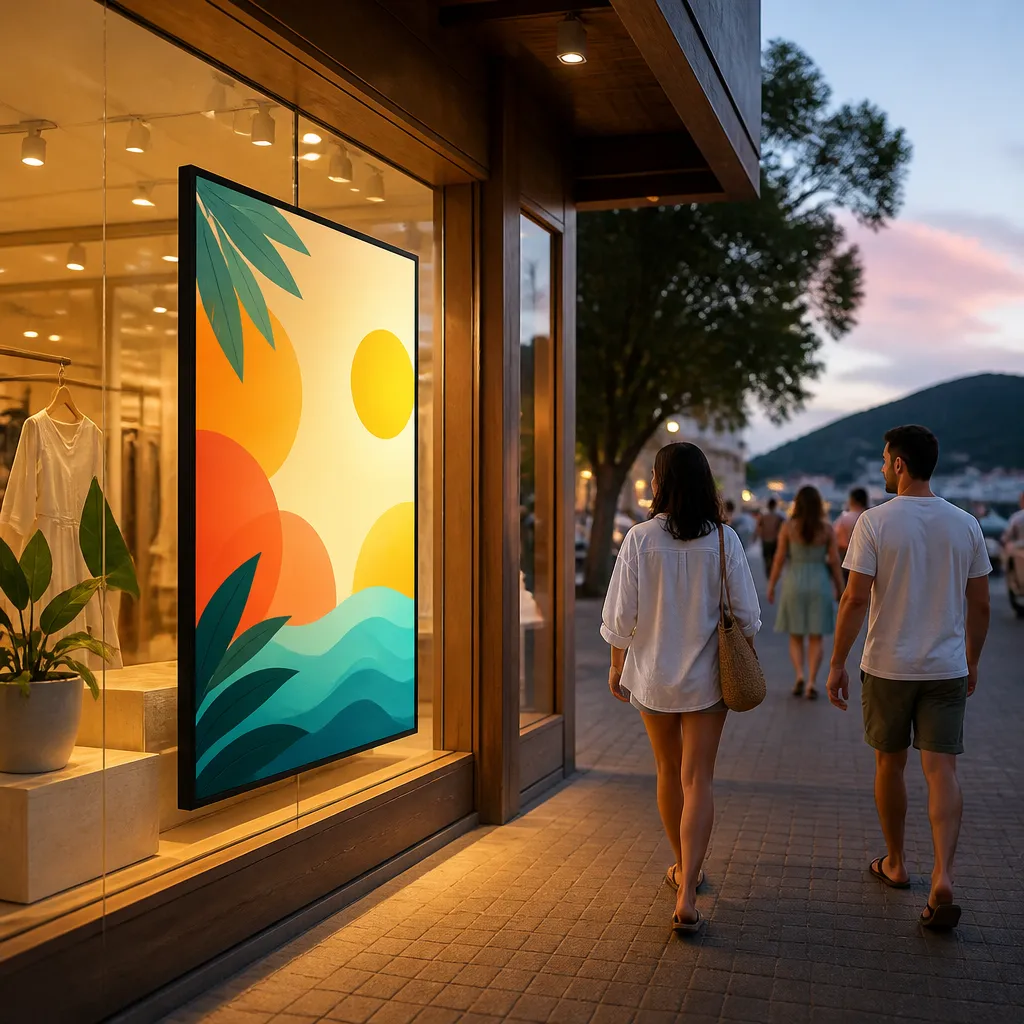
Lightspeed’s summer window guide makes the point that a strong display does more than look good, because it acts as your first sales touchpoint. In a few seconds it captures attention, shows what your business is and sets expectations for what is inside. Done well, a window can increase foot traffic while also pre-qualifying customers, so the people who come in already know what they came for.
A window is the first sales conversation a passer-by has with your business. In summer that conversation happens in bright light, at walking pace, and it is usually over in seconds.
In practice, the common failure is treating the window as seasonal decoration rather than a daily sales tool. A shopfront that still shows winter stock in January tells the street nothing new, and in a busy summer week, nothing new means nothing gets noticed. The fix is not a bigger budget. It is a window that is checked, lit and updated on a schedule.
Pro tip: Walk the footpath at the time of day your busiest passers-by arrive and look back at your window from a few steps away. If you cannot read the main message from that distance, a customer walking past at pace will not read it either.
Lighting the Window for Longer Summer Evenings
Summer evenings stay light later, which tempts many owners to switch off the window lights early. That is a mistake for any shop that trades into the evening, because a lit window is one of the clearest signals that a business is open and worth stepping into. Lighting is also one of the cheapest upgrades most shopfronts can make.
Brightness and colour temperature
One storefront merchandising guide recommends lights with low to mid-range Kelvin values, under 4500, because they give warm and welcoming tones rather than cold, clinical light. For a café or restaurant that is almost always the right choice, since warm light makes food and interiors look inviting. Retailers selling clothing or fabrics also tend to benefit from warm light, while grocery and plant displays often look better under brighter, full-spectrum light.
Direction matters as much as colour. The same guide suggests placing lights close to the glass, spaced 18 to 24 inches apart, and aiming them back into the display rather than into the eyes of pedestrians. A light that dazzles someone on the footpath pushes them away from the window.
Timers and evening hours
Many window lights run on timers that switch off once evening trade has finished. In summer, review those timers every few weeks, because the times of sunset and trading shift. A timer set in spring can leave the glass dark during the busiest late-afternoon walk, so check it on the first warm evening of the season.
For backlit displays, the case for always-on lighting is stronger. An LED backlit real estate display is built for 24/7 advertising, so it keeps working for property enquiries after the office closes. The real question is not whether the display should be bright, but whether its brightness is aimed at the right audience at the right hour.
Content Plans That Match Summer Shopping
Summer shoppers need a reason to stop, and the content on your glass should supply one. Lightspeed’s summer guide lists themes such as beach and coastal looks, tropical escapes, outdoor living scenes and a clear summer sale spotlight. Each theme has a job, and the right choice depends on what you sell and how your customers use it.
Themes that suit summer
Themes work because they give passers-by a mental picture. A beach or coastal scene can suggest escape, which encourages someone to keep looking for longer. An outdoor living or picnic set shows products used together, which is a practical way to encourage larger purchases. Lightspeed notes that when customers see products used together, they are more likely to buy several items.
Keep the colour palette tight. Lightspeed suggests limiting a tropical scheme to two or three dominant colours, and that advice holds for any summer window. Once a display uses five or six competing colours, the eye has nowhere to land and the offer disappears.
Rotating offers through the season
A summer sale banner only works when it is specific. “SUMMER SALE” tells a passer-by very little, whereas a clear offer with a time limit gives them a reason to act today. Rotating the window every week or so keeps regulars from walking past a display they have already memorised.
Pro tip: Plan window content in the same calendar as your promotions. A display that announces a weekend offer on Monday is useless by Friday, so schedule the change before the offer goes live.
Hardware for Bright Days and Hot Glass
Summer sunlight is the biggest practical problem for any screen in a shopfront. A display that looks crisp at eight in the evening can wash out completely at two in the afternoon when direct sun hits the glass. Choosing hardware for the brightest hour of the day, rather than the average, is what separates a working window from a wasted one.
Sunlight-readable screens
Standard indoor screens are built for dim offices, not shopfronts. For windows that take direct afternoon sun, specify sunlight-readable panels with enough brightness to hold contrast against reflections. Test the screen at the hour when glare is worst, not in the showroom under soft office lighting.
Glare is not only about brightness. Reflections from the street, parked cars and passing traffic can bounce off the glass and hide the content. Setting the screen slightly back from the glass and keeping text large and high contrast reduces the problem considerably.
UV-protected and hanging displays
Sun also damages what you have already paid for. UV-protected LCD screens are designed for windows that receive strong sun for long hours, which helps protect the display itself. Printed materials can also fade when left in the glass without protection, so check them regularly during summer.
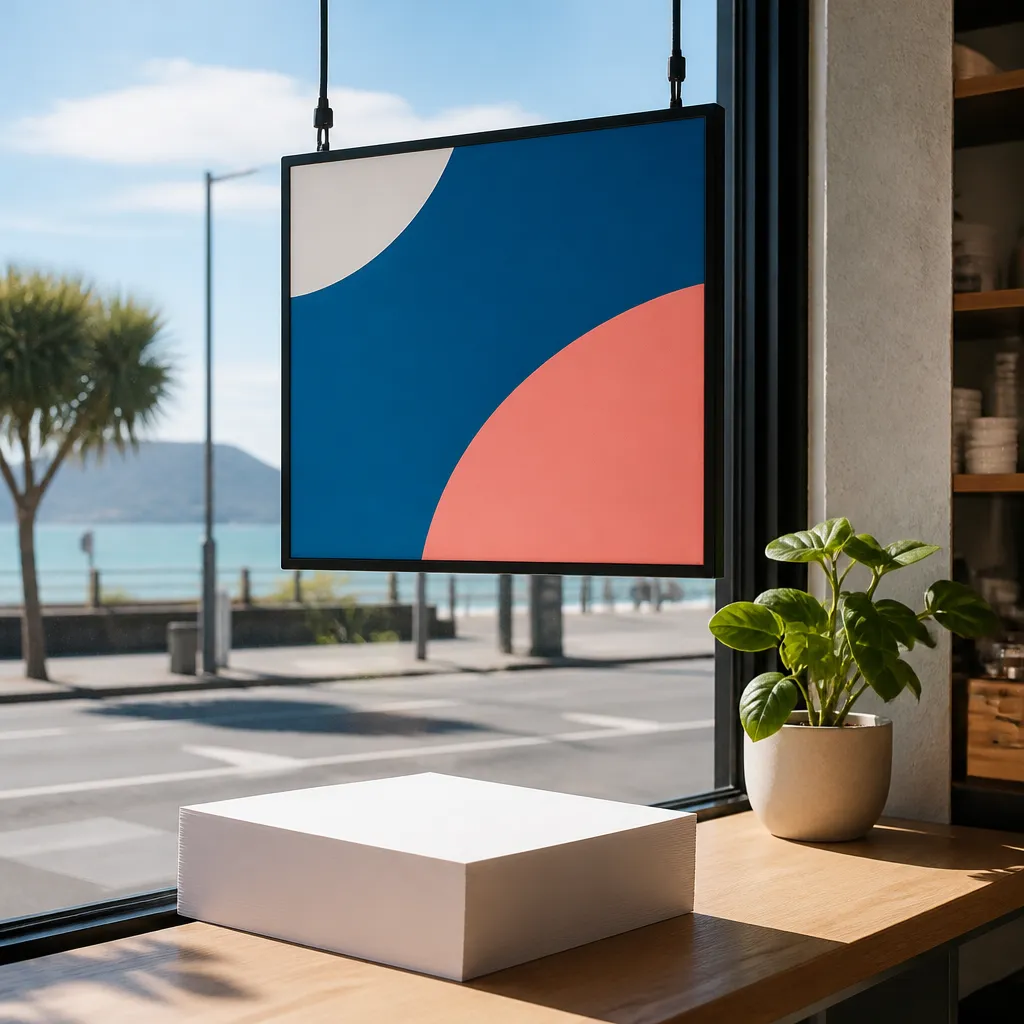
For narrow shopfronts or cafés with limited wall space, hanging cable LCD displays can suspend a screen in the window without a deep frame. That keeps the view into the store clear, which matters because customers who can see inside are more likely to step in.
Comparing Display Approaches for Summer
Not every shopfront needs the same setup. The right choice depends on how often your content changes and whether you trade into the evening. The table below compares three approaches that suit different summer businesses, and it is a starting point for weighing trade-offs rather than a ranking.
| Approach | Best suited to | Summer trade-off |
|---|---|---|
| Static backlit printed display | Cafés with a fixed menu, agencies showing a steady set of listings | Low running cost, but every change needs a manual swap, so offers can go stale quickly. |
| Digital LCD window screen with remote content | Retailers running weekly promotions or several messages across the day | Rotates content and changes by time of day, but needs power, a network connection and proper content planning. |
| LED backlit real estate display | Property agencies advertising listings around the clock | Strong evening presence and long-life construction, but the content works best when it follows your listing workflow. |
The cheapest option is rarely the cheapest over a full season. A printed display that needs weekly manual changes can cost more in staff time than a screen that updates itself. Work out how many content changes you will make across summer before you choose.
Remote Management and Fresh Content
The practical problem with a digital window is rarely the screen itself. It is the staff time needed to keep it updated. If someone has to visit the shop, plug in a drive and reset the playlist, updates slip. Remote content management removes that bottleneck by letting the team change the window from a phone or laptop.
Scheduling from a phone
Schedule the daytime promotion, the late-afternoon message and the closing message in advance, so the window keeps working on days when the manager is off site. V Media’s remote content management runs over WiFi, and its Android-based scheduling and automation let you set those changes ahead of time. In practice, a weekly schedule built on Sunday evening saves more time than a rushed change on Monday morning.
Connecting content to your other systems
If your team already uses a CRM or content management system, link the window to it rather than retyping offers by hand. CRM and CMS integration is included in V Media software subscriptions, so a promotion entered once can reach the glass. Confirm with your provider how each integration behaves before you rely on it for a live campaign.
Pro tip: Keep a fallback slide on every screen showing your opening hours and phone number. If the network drops during a busy weekend, the window still gives a passer-by something useful to read.
Measuring Whether Foot Traffic Actually Rises
A new window display feels successful when it looks good, but feeling is not evidence. Storerocket’s guide to increasing foot traffic covers measurement alongside local search, social media, events and promotions, and any of those can shift your numbers as much as the window does. Isolate the window’s effect as far as you can by changing one thing at a time.

Simple before and after counts
Count visitors or enquiries for two weeks before a window change and two weeks after, using the same days of the week. A tally sheet by the door is enough for most cafés and agencies, and a basic door counter is better if you have one. Compare like with like, because a Saturday and a Tuesday are not comparable.
Linking window offers to enquiries
Give each window offer its own code or question, such as asking customers which promotion brought them in. AJ Creative Studios’ guide to retail foot traffic argues that local targeted promotions and ads are essential for attracting foot traffic, so the window should carry an offer that connects to your wider local marketing. If a window message has not produced a single enquiry in a month, change it.
Adapting Summer Plans Across New Zealand Cities
Shopfronts in Auckland, Wellington, Christchurch, Tauranga, Hamilton and Dunedin rarely face identical summer patterns. Trade rhythms differ between a busy city centre and a neighbourhood strip, so one window plan seldom fits every shop. Treat the advice here as a framework to test locally rather than a fixed rulebook.
Visitor-facing and high street shops
Shops on busy visitor routes can lean into bright, short-message displays that suit people passing with time to explore. Visitors read less closely, so put the offer in large type and keep the rest of the screen simple. Test a clear “open now” message during peak visitor hours against a standard promotion and keep whichever gets more visits.
Neighbourhood cafés and agencies
Local regulars walk past the same window every day, so variety matters more than scale. Rotate the menu, a community event or a new listing every week, and keep your brand colours consistent so the window is recognised even when the content changes. Real estate agencies can apply the same approach by pairing a current listing with a short neighbourhood update.
Frequently Asked Questions
How bright should a summer window display be?
Brightness should be set for the sunniest hour your window receives, not the average. Test the display at that hour, and if the content washes out, choose a sunlight-readable panel with more brightness rather than pushing contrast on an indoor screen.
Do I need a digital display to get more foot traffic?
No. A well-lit printed display with a clear offer and fresh content can attract customers, especially for a café with a fixed menu. Digital screens earn their cost when you change messages often or need to show different content at different times of day.
How often should I change my window content in summer?
For most shops a weekly change works well, with faster changes for flash sales or events. Regulars walk past often, so a window that never changes stops being noticed within a few weeks.
Can remote management help a business with no manager on site?
Yes. Remote content management over WiFi lets you schedule and update the window from a phone or laptop. Load the week’s content in advance so the display keeps working when nobody is on site.
What is the simplest way to tell whether a window display is working?
Count visitors or enquiries for two weeks before a change and two weeks after, comparing the same weekdays. Link each offer to a specific question at the counter or in your enquiry form, so you can see which message is doing the work.
Tell us what has worked for your shopfront this summer, and which window message you dropped after a week because it did not move anyone.
We would love your feedback and any insights you would share with others. What perspective would you add?