

Christmas Window Display NZ: Retail Ideas That Sell
Most shopfronts in New Zealand are already deciding what goes in the window, and a Christmas window display NZ shoppers will actually notice takes more than a string of tinsel. Christmas is about five and a half weeks away. In December the sun sets late and people walk past in shorts and sunglasses, so a festive window that looks right in a northern winter can look flat here. This guide covers ideas for retail, cafés, restaurants and real estate agencies, along with the technology choices and checks that decide whether a display earns its place.
Table of Contents
- Quick Takeaways
- Why December Windows Work Differently in New Zealand
- Festive Window Ideas for Real Estate Agencies
- Retail Christmas Display Ideas by Theme
- Christmas Ideas for Cafés and Restaurants
- Choosing the Right Display Technology
- Running Festive Content Without Visiting the Shop
- Compliance and Energy Checks Before You Install
- Frequently Asked Questions
- References
Quick Takeaways
| Key Insight | Explanation |
|---|---|
| Install in late November | Gift lists form early. V-Count’s 2026 guide reports that 42% of US holiday shoppers planned to start before November, so a window that goes up on 1 December arrives late. |
| Design for summer evenings | December daylight lasts well into the evening, but footfall peaks after dark. Use glow or motion so the window still works at 8pm. |
| Put one price or gift cue in the glass | Shoppers decide in about three seconds. A single readable cue, such as “gifts under a set amount”, does more than a wall of small signs. |
| Use one focal point at eye level | Two competing messages cancel each other out. Pick one headline, one product group and one moving element per window. |
| Schedule content weeks ahead | Write the December calendar before you design anything, so Boxing Day offers go live on time and expired offers come down on time. |
| Check festive claims before they go live | Limited-time offers need an end date and savings need a reference price. Advertising rules apply to window copy the same as any other advertising. |
Why December Windows Work Differently in New Zealand
The most common mistake we see is treating a Christmas window like a northern hemisphere display with a few summer props added. In New Zealand, December trading runs through long evenings and warm afternoons, and the people walking past are often on foot, heading to the beach, the café or a late shop. That changes what stops them.
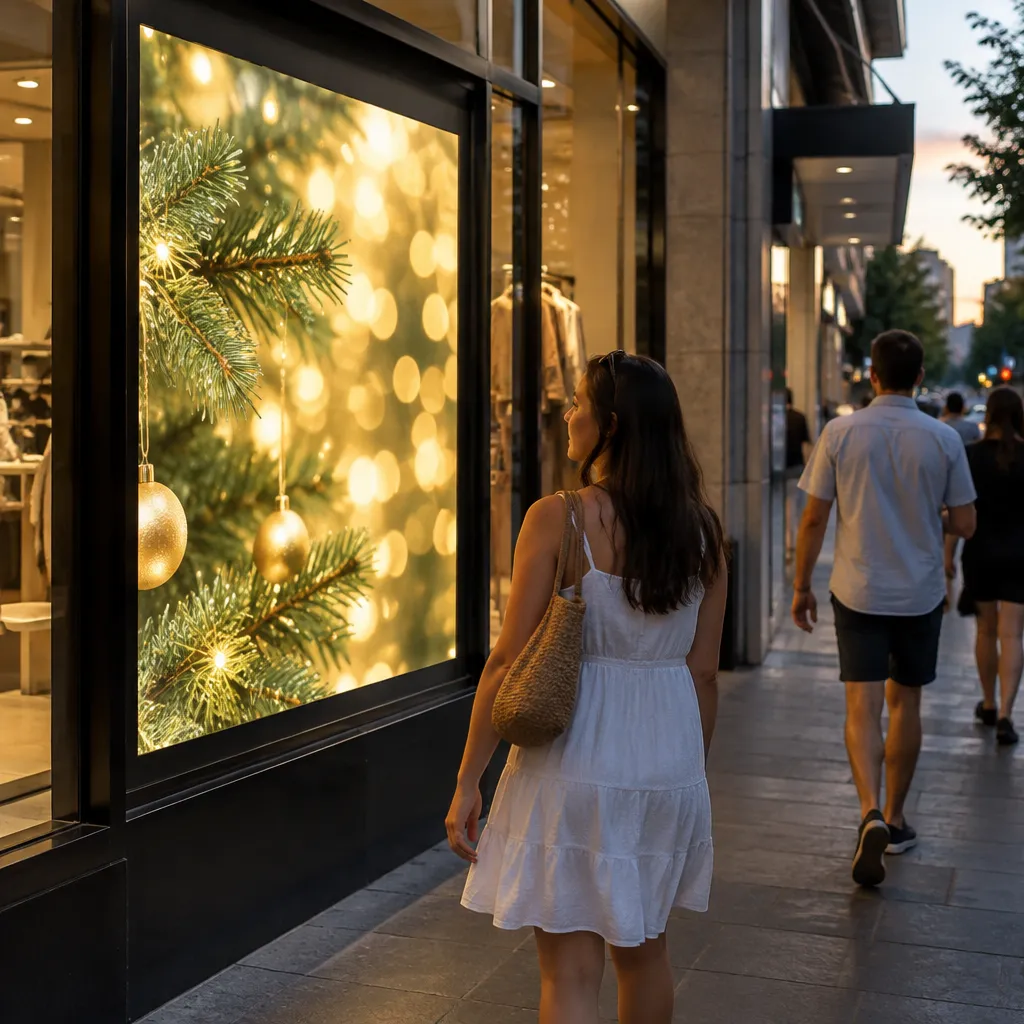
V-Count’s 2026 guide puts the time a shopper has to notice a window at about three seconds, based on someone walking at normal pace past a five-metre shopfront. That figure comes from a guide aimed at US retailers, but the arithmetic holds anywhere. In three seconds, a window has to show one message, one focal point and one reason to walk in.
Summer light and late evenings
Daylight in December lasts well into the evening, so a window that looks good at 2pm may look dark and empty by 8pm, which is when many people do their gift shopping. Glow matters here. A backlit panel or LED display keeps the message readable after the sun drops, and it keeps working for the people walking home.
Early decisions, not last-week installs
Install in late November, not on the first Monday of December. Shoppers start comparing gifts earlier than most owners expect, and a display that arrives after the list is written has missed the sale. Run a simple test: stand a few metres back from the glass on a bright afternoon and read your headline. If you cannot read it in one pass, the next passer-by will not either.
Pro tip: Photograph your current window from the footpath at 2pm and again at 8pm. The two photos show you exactly where your message disappears, and that is the part of the window to fix first.
Festive Window Ideas for Real Estate Agencies
Real estate agencies have a different Christmas problem. Their windows already show property, so the festive angle has to support the listings rather than compete with them. The best agency windows treat the season as a reason to look, not as decoration to admire from across the street.
Backlit listing previews that run after dark
Run a rotating set of current listings on a backlit real estate display, with the address, bedroom count and the next open home time on each slide. Keep each slide on screen long enough to read the headline, usually a few seconds, and fit the whole loop into a short cycle so nobody waits through an advertisement for a property they have already seen. Schedule your strongest listings for the early evening, when people are out and looking at homes after work.
Open home dates on a rolling loop
Holiday open homes need a clear calendar. A dated panel showing Saturday and Sunday viewing times, updated from your scheduler rather than printed and stuck to the glass, avoids the awkward moment when a viewing from weeks ago is still advertised. Remote content management makes this a few minutes from the office instead of a trip out to the shopfront with a ladder.
Seasonal neighbourhood guides
A short seasonal guide to the suburb, covering the local Christmas markets, the beaches worth visiting in summer or the café that stays open late, gives passers-by a reason to stop even if they are not in the market to buy. Keep it local. Auckland, Christchurch, Wellington, Tauranga, Hamilton and Dunedin each have neighbourhoods with their own character, and generic national imagery reads as lazy to the people who live there.
Pro tip: If your CRM holds open home times, connect that export to your content schedule so dates never drift out of sync with the agent’s calendar.
Retail Christmas Display Ideas by Theme
Retail windows need to show a product, a price or a gift idea within a few seconds, and vague festive mood rarely converts. Pick one of the approaches below and commit to it for the whole season. Changing theme every week confuses regular customers who recognise your window from the other side of the road.
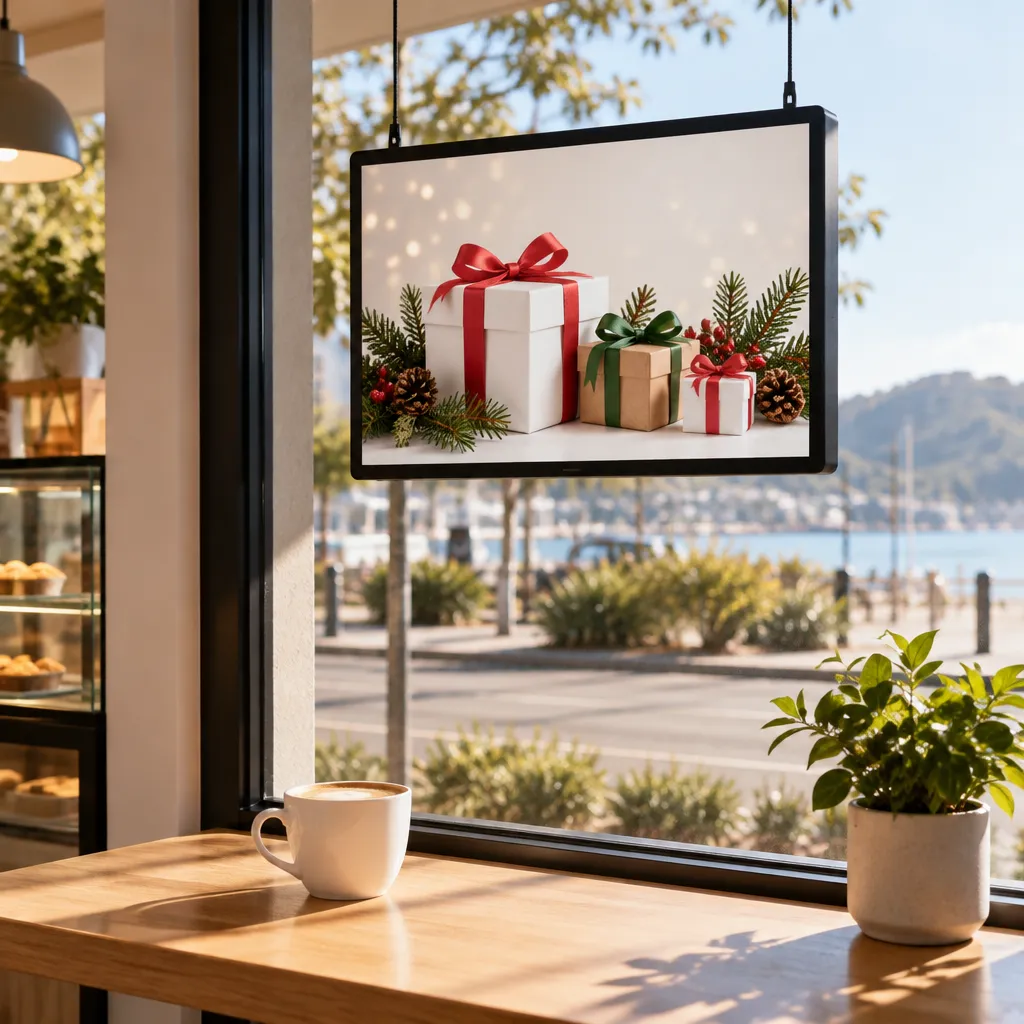
A window does not need to be clever. It needs to be readable in the time it takes someone to walk past.
Gift-led layouts with a clear price cue
Group products by the person they suit, such as for her, for him, for the teacher or under a set budget. One price cue, written large in one corner, does more than a dozen small price tags. Use real stock rather than styled props, so the window matches what is on the shelf when the customer walks through the door.
Pro tip: Put your highest-margin gift group at the corner nearest the footpath entry point. People tend to look at the end of a window they reach first, so that is where a gift cue earns its keep.
Motion and glow for after-dark trade
Motion catches the eye faster than colour. A looping LED or LCD sequence showing three product shots, each held for a few seconds, beats a static poster once the sun goes down. The rule is one moving element per window. Two moving panels compete with each other, and the eye gives up on both.
Kiwi summer themes instead of snow
Snow scenes look out of place on a hot afternoon, and shoppers notice. Try summer Christmas cues instead, such as pōhutukawa red, sand tones, a beach towel draped over a gift bag or a hamper ready for a summer barbecue. These feel local and avoid the cliché of a fake winter scene. Keep the palette to two colours plus white so the glass reads clearly from the footpath.
Christmas Ideas for Cafés and Restaurants
Cafés and restaurants win December on function bookings, takeaway orders and gift vouchers. Your window should push one of those three. A menu board showing the full range does not make anyone decide to come in for a Christmas lunch.
Festive specials on a backlit panel
Put one festive special on a backlit panel at eye level, with the price and the days it is available. Change it weekly so regulars see something new when they pass. Keep the full menu inside, where people can read it once they are already at the door.
Function bookings with a visible deadline
Office Christmas lunches fill early in December, so the window should carry a deadline. Show the booking phone number or link and the date bookings close, then update that date as the function calendar fills. A panel that stays the same for three weeks looks like the venue is not busy, even when it is.
Gift vouchers and takeaway cues
Gift vouchers suit the final two weeks before Christmas, when people are looking for a last-minute present. A short loop showing the voucher options and the online order link captures people who are walking past on the way to a shop they have not chosen yet. Takeaway cues work the same way for the office gatherings that happen in the week before the holiday.
Choosing the Right Display Technology
The right display depends on how often the message changes, how deep your shopfront is and how many hours it needs to run. Most New Zealand shops mix two options, a fixed backlit panel for the long-running brand message and a digital screen for the offers that change. Below are the three options we see most often.
Printed backlit paper for short, low-cost changes
Premium backlit printing paper suits a message that changes a few times a season and needs to look sharp in a lightbox. Print in A3 or A4 for small panels, or in larger formats for feature windows. The trade-off is that you swap the paper by hand, so plan a changeover date and do not leave a faded December message up in January.
Hanging cable LCD for shallow shopfronts
Hanging cable LCD displays suit narrow windows where a floor mount would take up too much room. They work well for a single product loop or a brand message. Check the glass depth and the position of the nearest power point before ordering, because the cable run decides where the screen can sit.
LED backlit displays for round-the-clock brightness
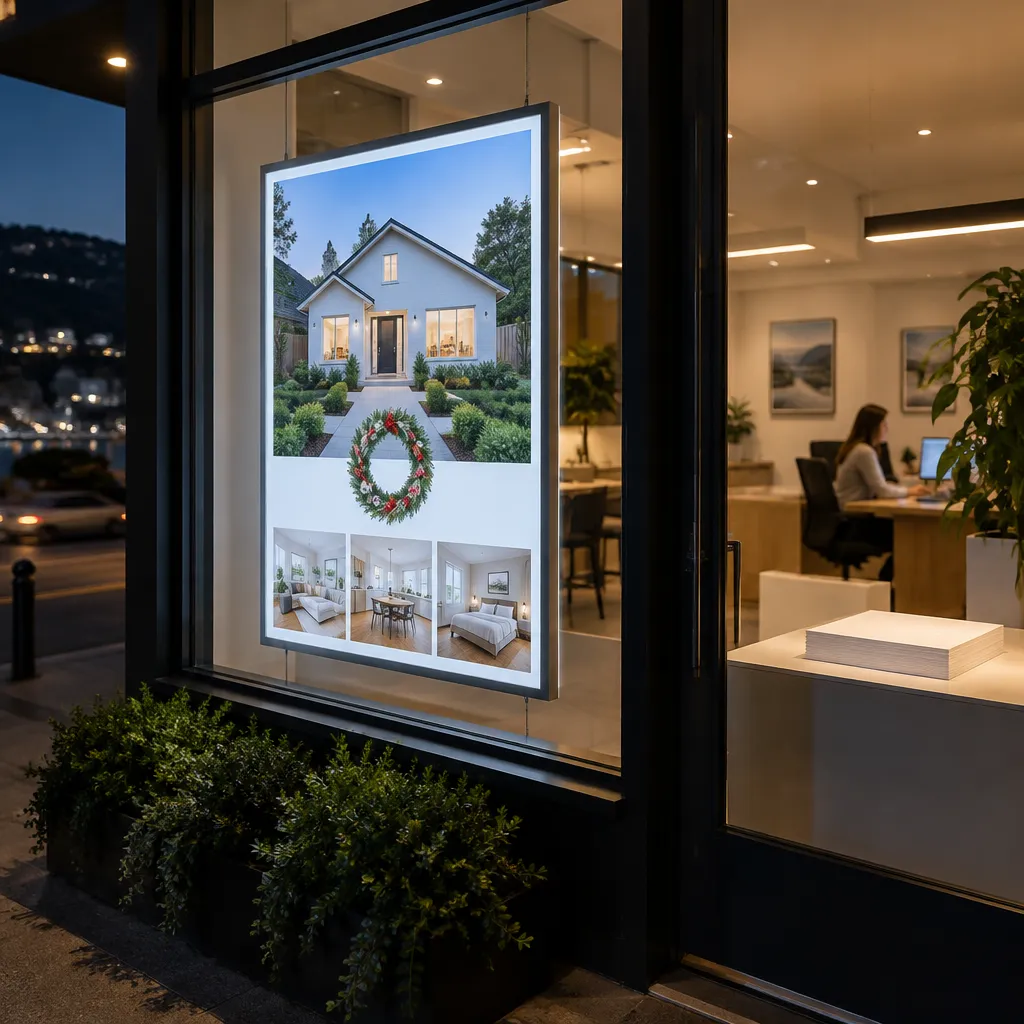
LED backlit real estate displays are built for continuous running, which suits agencies and shops that want the window lit all night. They have a higher upfront cost than paper, so compare the cost per season rather than the cost per panel. For a window that will carry a message from late November into the new year, that comparison usually favours the longer-running option.
| Option | Best fit | Trade-off |
|---|---|---|
| Premium backlit printing paper | Short seasonal messages in lightboxes, A3 or A4 panels | Manual swaps and a fixed message until someone changes it |
| Hanging cable LCD display | Narrow shopfronts with limited floor space and a rotating product loop | Cable routing and power access must be planned before install |
| LED backlit real estate display | Agencies and shops that need a bright, long-running window through the night | Higher upfront cost, so compare the cost per season |
Running Festive Content Without Visiting the Shop
A Christmas window that changes on schedule is what keeps a display working through a season of roughly six weeks. Manual updates tend to fail. Someone forgets, the Boxing Day sale stays up until February and the window starts to look abandoned. Remote content management fixes that problem.
Building the December content calendar
Write the calendar before you design anything. Map out each week from installation to 26 December, list the message for each week and the date it goes live. Keep one evergreen loop, such as your brand or your address, so the window never goes blank if a schedule slips.
Linking offers from your CRM and CMS
V Media software subscriptions include CRM and CMS integration, so an offer entered once can flow through to the window. In practice, that means a sale price changed in one place updates the glass, rather than someone updating three systems on a busy Friday afternoon.
Scheduling and sunlight-readable screens
Android-based scheduling lets you set different loops for weekday daytime, weekend evenings and public holidays. Sunlight-readable screens matter in a New Zealand summer, because a screen that looks sharp at night can wash out at 2pm on a clear day.
Pro tip: Set a Boxing Day and a New Year end date on every promotional loop when you build it. Expired offers are the fastest way to make a festive window look neglected.
Compliance and Energy Checks Before You Install
Two checks catch most problems before a display goes up: whether your festive claims are truthful, and whether your energy choices meet current rules. Neither takes long, and both are easier to settle before the screen is mounted.
Festive claims that hold up
The Advertising Standards Authority has published Christmas advertising tips in past seasons, and its guidance is a sound baseline for window copy. Limited-time offers need an end date, savings need a clear reference price and any “lowest in town” claim needs evidence behind it. Write each claim as if a shopper will test it on the day they come in.
Energy rules for electronic displays
EECA publishes a page on energy efficiency standards and labelling for electronic displays and digital signs in New Zealand and Australia, and the page describes those requirements as under review. Confirm the current position before you buy, and ask your supplier how the screen’s power use is set up for after-hours running. A timer that dims or switches the screen off overnight is a simple saving for a window that does not need full brightness at 3am.
Frequently Asked Questions
When should a shop install its Christmas window display in New Zealand?
Late November is the safest window for most retailers. That gives the display a few weeks of visibility before the heaviest gift shopping, and it leaves room to fix anything that is hard to read from the footpath.
Are snow and winter themes still worth using in a New Zealand summer?
Usually not. A snow scene can work in a small corner, but a full winter theme on a hot December afternoon looks out of place. Summer Christmas cues, such as local colours, beach or barbecue imagery and hampers, tend to feel more natural to local shoppers.
How many elements should one window display have?
One focal point, one headline and one moving element is a practical limit. Extra items can sit inside the shop where people see them once they walk in.
Can a real estate agency run a Christmas window without changing its listings?
Yes, but the festive element should sit alongside the listings rather than replace them. A seasonal neighbourhood guide or a set of open home times keeps the window useful while it carries the holiday theme.
Does a digital window display need special setup for Christmas?
It needs a plan for content, power and brightness. Remote management over WiFi lets you schedule loops in advance, and a sunlight-readable screen keeps the message visible on bright summer afternoons. Check the mount and power point before the installation date.
How do you know whether the window display worked?
Compare weekly foot traffic, the number of people who step inside and any sales that mention the window offer. Take the same photographs from the footpath each week so you can see which messages held attention and which faded.
What has worked best in your window this festive season, and what would you change for next year?