

Realestate Window Signs That Sell Listings 24/7 in NZ
A listing that lives only on a property portal competes with every other listing on the same screen. A listing in your street-facing window competes with the shops and cafés around it, and it has one advantage no portal can match: it sits where buyers walk past in person. That advantage is biggest after dark, when a lit display keeps working while the team has gone home. Realestate window signs only pay off when they are bright enough to read in daylight, simple to update from the office, and built for the longer days of spring and summer. This guide covers what to show, which hardware suits which frontage, and where agencies waste money.
Table of Contents
- Quick Takeaways
- Why Window Signs Work After Dark
- Spring Listing Timing for Window Displays
- Content That Sells the Listing
- Hardware That Survives Sunlight
- Remote Updates and Scheduling
- Choosing a Window Display Approach
- Common Mistakes to Avoid
- Frequently Asked Questions
- References
Quick Takeaways
| Key Insight | Explanation |
|---|---|
| Window signs work hardest after hours | A lit display keeps showing your listings on the evening walk home, when a paper flyer has gone dark. |
| Start the refresh in late September | Spring open homes arrive in a rush. Load content before the first heavy weekend, not halfway through it. |
| Rotate listings, sold results and market data | A mix of current listings, recent sold results, one market data slide and a contact slide gives passers-by more than one reason to stop. |
| Specify screens for sunlight, not showroom light | Midday sun on a shopfront washes out standard indoor panels. Choose sunlight-readable screens and UV-protected LCD panels for any window that gets direct sun. |
| Update from the desk | Remote content management over WiFi lets you swap a listing the same afternoon it goes live or sells. |
| Keep each message to one idea | A passer-by gives a window a few seconds. Three listings, a price table and a paragraph of text will be skipped entirely. |
Why Window Signs Work After Dark
Signage guides written for property professionals make a consistent point: physical signs catch the attention of people who were not searching for a home at all. They reach local residents, regular passers-by and neighbours who know someone thinking about moving into the area. In neighbourhoods where word of mouth travels fast, a window display can start that conversation before anyone types a search term.
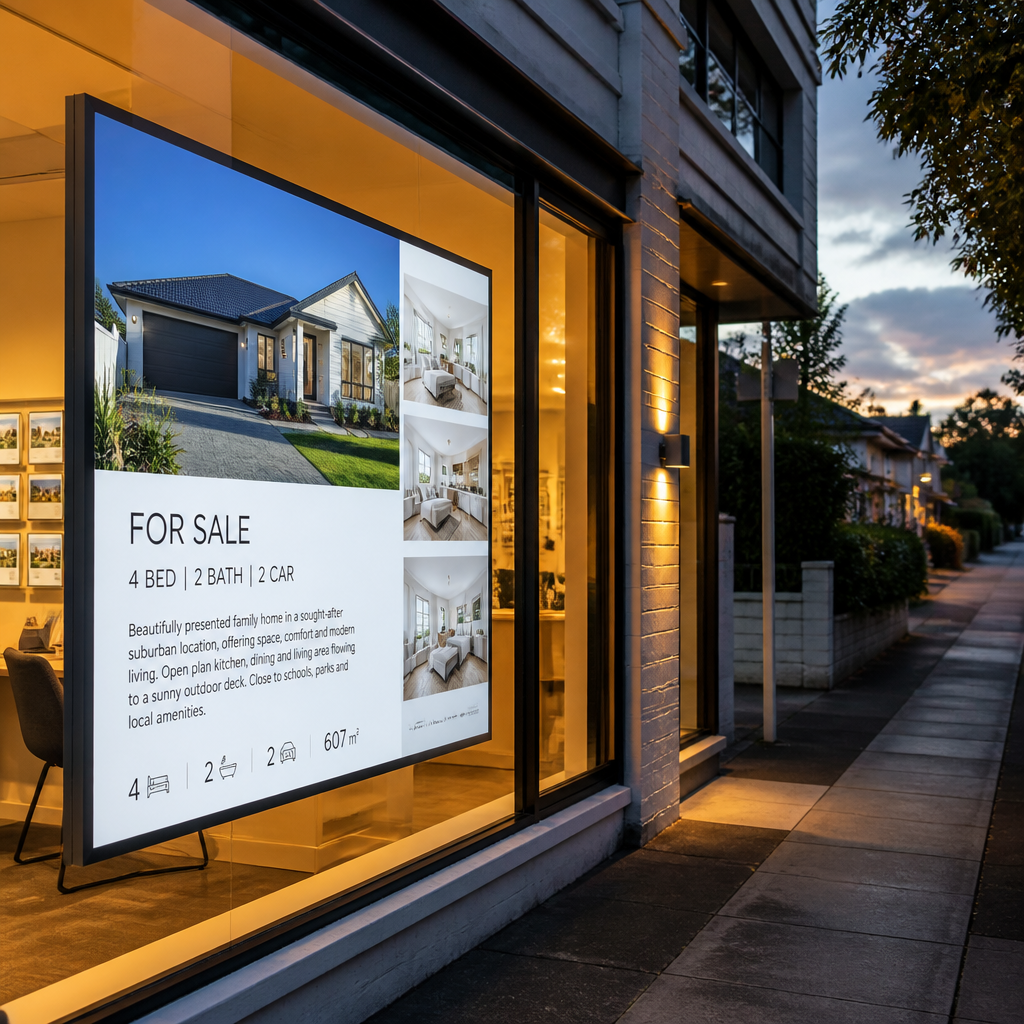
Night-time visibility on a busy street
A printed sheet behind glass goes invisible once the streetlights take over, and most people pass shopfronts in the evening rather than during office hours. An LED backlit display or LCD screen keeps the listing lit for the commute home, the evening walk and the Saturday stroll. Whether your office is in Hamilton, Tauranga, Dunedin or Christchurch, the pattern is the same. The window is often the only piece of marketing still working after the team locks up.
In practice, the best position for a display is one where a pedestrian can read the top listing from the footpath without stopping. If they have to step closer to read the price, most of them will keep walking. Test the sightline from the street before you commit to a mounting height.
Credibility from a well-kept window
Window displays also do quiet work on the vendor. A sharp, current screen tells a homeowner walking past that the agency is actively marketing and keeps its material up to date. A faded page taped to the glass says the opposite. For many vendors, the window is the first place they form an opinion about an agency, and it is the thing they glance at while waiting for a meeting in the reception area.
That credibility carries over to listings that are not in the window at all. A vendor who sees consistent, professional presentation in the shopfront is more likely to assume the same standard applies to their own campaign.
Spring Listing Timing for Window Displays
Spring in New Zealand runs from September to November, and for most agencies it is the period when listing volume rises. Open homes cluster on weekends, daylight stretches into the late afternoon, and more people are out walking the main streets. A window refresh has to be live before that first heavy weekend. Displays that go up mid-campaign miss the early wave of buyers, who often move fastest.
Set up the window in late September. That means choosing the listing mix, loading the content and testing the schedule while the first open homes are still being booked. Do not wait for a property to sell before you plan its replacement. Keep a rolling list of the next three listings so the window never runs out of fresh material.
Why late September is the right starting point
Early setup gives you time to fix problems before they cost you a weekend. Text that is too small, a photo with the wrong crop or a schedule that loops too quickly all show up within the first few days on screen. Finding them in late September is far better than discovering them during the first open home of the season, when the sign is already the main thing people see.
Pro tip: Build the spring content set in a single session and schedule it to change at set times of day, such as a morning listing block and an evening block. Two clear blocks are easier to manage than constant manual edits.
Planning content for the summer peak
Summer brings longer evenings, so the window is visible for more hours each day. Through December and January, many agencies notice enquiry patterns slow around the Christmas and New Year period. Use that stretch to show recent sold results and a simple market summary rather than leaving the same current listings on a loop for weeks. The window keeps your agency visibly active when phones are quieter, and it gives the next wave of vendors a reason to book a valuation.
Content That Sells the Listing
The content on a window display matters more than the hardware in the first month. A bright screen full of the wrong information is a billboard for nothing in particular. Good content answers three questions in a few seconds: what is for sale, how do I get more information, and who is the agent. Everything else is secondary.
Guidance from digital signage providers for real estate suggests a rotation that mixes current listings, recent sold results, one market data slide and a contact slide. We agree with the structure, but we would put the sold result near the top of the loop, because it is the proof that makes the listings credible.
Rotating listings without clutter
Limit the active rotation to three listings at a time. Each listing should have one strong photo, a price or price guide, one headline benefit and a single contact line. More than three and the viewer cannot read any of them before the screen changes. A common mistake is loading the full brochure onto the screen, which turns a window display into a document that nobody reads.
Keep the text large enough to read from the far side of the footpath. If you need to walk to the glass to read the street number, the font is too small.
Sold results and the market data slide
Recent sold results do two jobs at once. They show buyers that the agency closes deals, and they show vendors that the agency can get a result in their street. Keep the sold slide current, and remove results once they are no longer recent enough to matter to the local market. A single market data slide, with one clear figure rather than a dense table, gives passers-by a reason to stop and vendors a reason to ask about a valuation.
The contact slide people actually use
The contact slide is the one most often ignored, yet it is the slide that turns attention into a phone call. Show the agent’s name, a mobile number and the office address. Keep it on screen for long enough to copy a number from the glass. If your schedule has a contact slide that appears for only a second or two, lengthen it. A person reading a phone number on a busy street needs several seconds, not a blink.
Pro tip: Put the agent’s photo on the contact slide. Local buyers and vendors often recognise a face before they remember a name, and a face makes the window feel like a person rather than a brochure.
Hardware That Survives Sunlight
Most window problems come from light, not from the content. A screen that looks crisp in a showroom can be unreadable at midday when sun hits the glass. The right hardware depends on how much direct sun reaches the window and whether the display runs around the clock. Ask about the sun exposure before you choose a panel, not after the first hot week of summer.
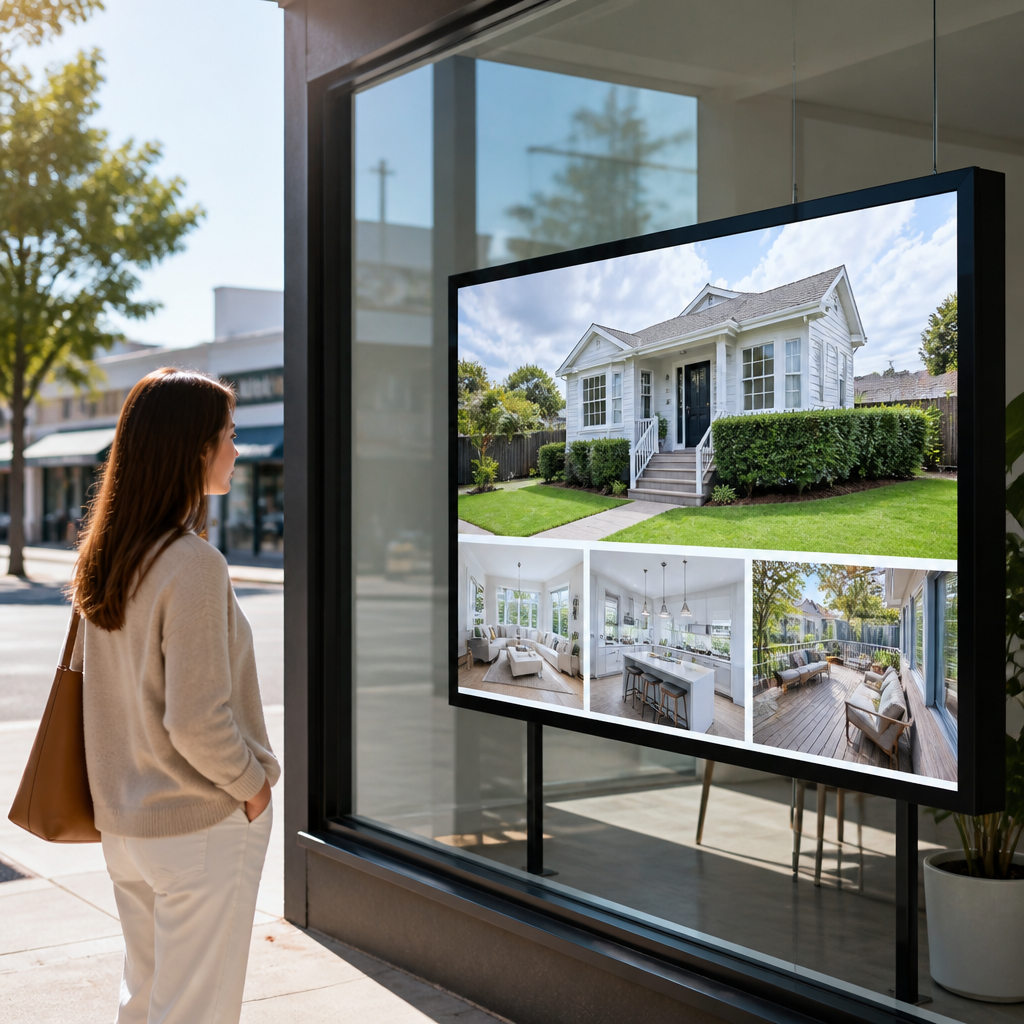
Glare, brightness and sunlight-readable screens
Brightness is only half the story. A sunlight-readable screen maintains contrast under strong ambient light, so the content stays legible in the afternoon as well as at night. Standard indoor panels are designed for offices and showrooms, where the light is controlled. Put one of those behind a sun-facing window and the image washes out, leaving a grey rectangle that reads as a dead screen.
Reflections matter too. Streetlights and the glass itself can bounce light back at the viewer. Position the screen so the reflection falls away from the main sightline, and test it at dusk as well as at noon.
UV protection for LCD panels
Panels that sit behind glass for years are exposed to sunlight every day. UV-protected LCD screens are built to handle that exposure, which matters for both the image quality and the life of the unit. If your window gets direct sun for part of the day, specify UV protection from the start. A cheaper indoor screen may look fine on its first day and then begin to fade through the summer months.
Hanging cable LCD versus LED backlit displays
Hanging cable LCD displays suit windows where the screen needs to sit close to the glass, or where a suspended mount works better than a fixed bracket. They are a good fit for tight frontages and for offices that want a clean, minimal look. LED backlit real estate displays suit agencies that want 24/7 advertising with a long life expectancy, particularly where the window faces the street after dark. In practice, the choice comes down to the space, the sun and how many hours the display must run each day.
Remote Updates and Scheduling
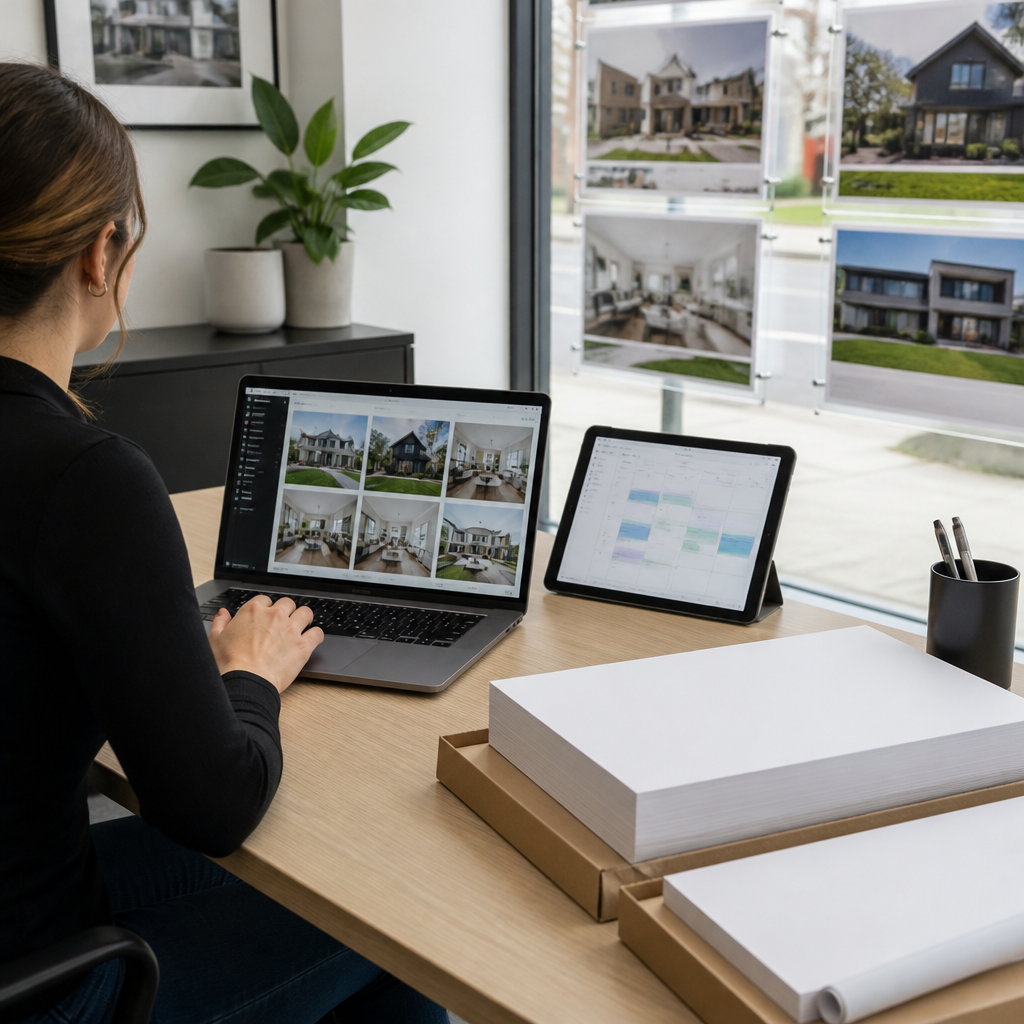
A window display is only as current as the last time someone updated it. Many agencies treat the screen as a project that needs a technician or a staff member on site, and the content quietly goes stale. Remote content management removes that friction. Updates go from the office desk to the screen over WiFi, so the window can change the same day a listing goes live or sells.
A window display is only as current as the last time someone updated it. Schedule the updates the same way you schedule open homes.
Changing a listing from the office
Remote content management means a new listing can replace an old one before the vendor has finished reading the agreement. Upload the photo, set the price guide and assign the slot in the rotation. The change is live without anyone walking to the glass with a screwdriver. This is particularly useful for agencies with several offices, where one team manages the window content for every location.
Build a habit of checking the screen once a week. Look at the live feed, confirm the sold listings are gone and make sure the contact details are still correct. Five minutes of checking prevents an out-of-date listing from sitting in the window for a fortnight.
CRM and CMS integration for consistent listing data
Listing details are often typed in two or three places: the CRM, the website, the portal and now the window. Each re-entry is a chance to introduce a wrong price or a wrong status. CRM and CMS integration reduces that risk by keeping the content tied to the source record. Our software subscriptions include this integration, so the listing data your team maintains is the same data the screen displays.
Scheduling by time of day
Android-based scheduling lets you show different content at different times. A typical pattern is current listings during business hours, sold results and the contact slide during the evening, and open home details on the days those events run. The schedule should follow how your street moves, not a fixed loop that ignores the time of day. Set the schedule once a week and review it when the open home calendar changes.
Pro tip: Name each content slot by its purpose, such as “Open home Saturday” or “Evening sold results”, rather than by a file name. When a team member takes over the window, the schedule is readable at a glance.
Choosing a Window Display Approach
There is no single best format for every agency. The right choice depends on how often the content changes, how much sun the window receives and how many hours the display needs to run. Printed paper is still useful for stable messages and budget-conscious campaigns, while digital screens handle frequent changes. The table below compares three practical approaches for realestate window signs.
| Approach | Best For | Trade-off |
|---|---|---|
| Static backlit paper displays using premium backlit real estate paper | Fixed brand messages, stable listings and bulk campaigns across several offices | Content cannot change remotely, so every update means a reprint and a physical swap |
| Hanging cable LCD displays | Tight frontages and offices that need a clean, suspended screen close to the glass | Needs a sound mounting point and careful cable routing, and the screen must be UV-protected if it gets direct sun |
| LED backlit real estate displays with remote content management | Round-the-clock visibility, frequent listing changes and agencies with more than one office | Higher upfront investment than paper, and the schedule still needs a regular review to stay current |
Three approaches compared
Paper suits agencies that want a clean, lower-cost look for stable messages, such as an agency brand panel or an estate campaign that runs for several weeks. It is simple to install and easy to replace, but it is limited by the reprint cycle. Hanging LCD suits spaces where the screen needs to work hard in a small footprint. LED backlit displays with remote management give the strongest after-dark visibility and the most flexible content, but they need a plan for the schedule as well as the hardware.
Matching the approach to the street
Start with the window, not the catalogue. Check how much direct sun the glass receives, how close pedestrians walk and whether the display needs to run after closing time. If the window faces a quiet residential street with little evening traffic, a static backlit paper display may do the job. If the window sits on a busy main street in Auckland, Wellington or Christchurch, where people pass in the evening, a remotely managed LED backlit display is more likely to earn its place.
Common Mistakes to Avoid
Most window displays fail for predictable reasons. The content goes stale, the text is too small, or the screen is not built for the light it receives. These problems are cheap to prevent and expensive to fix once the display is in front of the street. The same checks apply whether the agency is in Dunedin, Tauranga or anywhere else in New Zealand.
Leaving sold listings on screen
A sold listing still on the loop tells passers-by that the agency is not paying attention. Remove sold properties on the day they sell, and replace them with the next current listing or a recent sold result. Once a result is no longer recent, take it off the rotation as well. Stale content does more damage than an empty slot.
Make the sold removal part of the listing workflow, not an afterthought. If the person who updates the listing is the same person who updates the window, the risk drops sharply.
Too much text for a passer-by
Short, concise messages with readable fonts work best from a distance. Guidance on real estate signage consistently makes the same point: a cluttered sign is confusing. Pick one message per screen, one call to action and one contact method. If a passer-by needs to pause to decode the layout, they will walk on before they reach the phone number.
Ignoring reflections and glare
Many agencies test a window display at the desk and never at the glass. Check the screen at dusk, at midday and under streetlights. A display that looks fine indoors can be hard to read once the street lights come on, or once the afternoon sun reflects off the glass. Adjust the mounting angle, the brightness setting or the content contrast before you accept the final install.
Pro tip: Photograph the window from the footpath at three times of day and compare the images. The photos show glare and legibility problems faster than a close inspection inside the office.
Frequently Asked Questions
How many listings should a realestate window sign show at once?
Three is a practical limit for most windows. Each listing needs enough screen time for a passer-by to read the price and the headline benefit, and more than three listings usually means none of them get read in full.
Can a standard indoor screen work in a window that gets direct sun?
Usually not. Standard indoor panels wash out in strong light. Choose a sunlight-readable screen with UV protection if the window gets direct sun for part of the day.
Can we update the window content when no one is in the office?
Yes, if the display supports remote content management over WiFi. Updates can be made from another location, and the schedule can change content at set times of day without anyone on site.
Do window displays replace yard signs and printed flyers?
No. Window displays work alongside other physical signs and printed material. Yard signs catch the street attention on the property, while the window keeps the agency visible at the office and on the main road.
Does the software connect to our existing CRM or CMS?
CRM and CMS integration is included in our software subscriptions, so listing data can flow from the systems your team already uses to the screen. Confirm the details with the team before you start, because the set-up depends on your existing platforms.
Are the same window display principles suitable for agencies in smaller cities?
Yes. The core rules are the same in Hamilton, Tauranga, Dunedin, Christchurch, Wellington and Auckland. The main variable is the window itself, including how much sun it receives and how many people pass it after dark, so plan around the frontage rather than the city.
We would like to hear what your agency has learned from running a window display through a New Zealand spring and summer, so tell us which approaches have worked and which have not.
We would love your feedback and any insights you would share with others. What perspective would you add?