

Café Window Displays: How NZ Restaurants Fill More Seats
Most café owners only think about the front window when the glass needs cleaning. Yet the people walking past at half eleven on a weekday are already deciding whether to step inside, and they make that call in seconds. Digital window displays, from hanging cable LCD screens to LED backlit units, give cafés and restaurants a way to show the lunch special, the afternoon coffee deal or the evening menu without reprinting a sign every week. This guide covers how café and restaurant owners across New Zealand are using these screens to fill more seats, what hardware holds up in real New Zealand sun, and where most hospitality operators go wrong.
Table of Contents
- Quick Takeaways
- Why Window Advertising Works for Cafés
- What a Window Screen Needs to Survive NZ Sunlight
- Content That Fills Tables, Not Just Screens
- Menu Updates and Multi-Site Control
- Measuring Whether the Screen Fills Seats
- Comparing Window Display Options for Hospitality
- Common Mistakes That Waste a Window Screen
- Frequently Asked Questions
- References
Quick Takeaways
| Key Insight | Explanation |
|---|---|
| Passers-by decide in seconds | A single lunch special at a readable size beats a crowded menu board that needs someone to stop and read it. |
| Spec brightness for the afternoon | Screens facing the street need enough brightness to beat low afternoon sun on the glass. Ask for measured brightness in writing, not a vague “bright” claim. |
| Run separate dayparts | Breakfast coffee, lunch specials and dinner should run as separate playlists, each updated from a phone before the rush. |
| Pull expired offers the same day | An out-of-date promotion on a window screen tells passers-by the kitchen is out of date too, which is worse than a blank screen. |
| Use one call to action per frame | Show one offer and one reason to come in now, such as a table for two or a coffee and cake deal for the quiet afternoon hours. |
| Measure covers, not impressions | Count covers at the same daypart for two weeks before and after installation, and attach a unique voucher code to the screen offer. |
The window is the one piece of marketing a café owns outright. A customer does not need to search for you, download an app or follow an account before they see the offer. The moment they slow down on the footpath is the moment the screen has to earn their attention, and that window of opportunity is short.
Why Window Advertising Works for Cafés
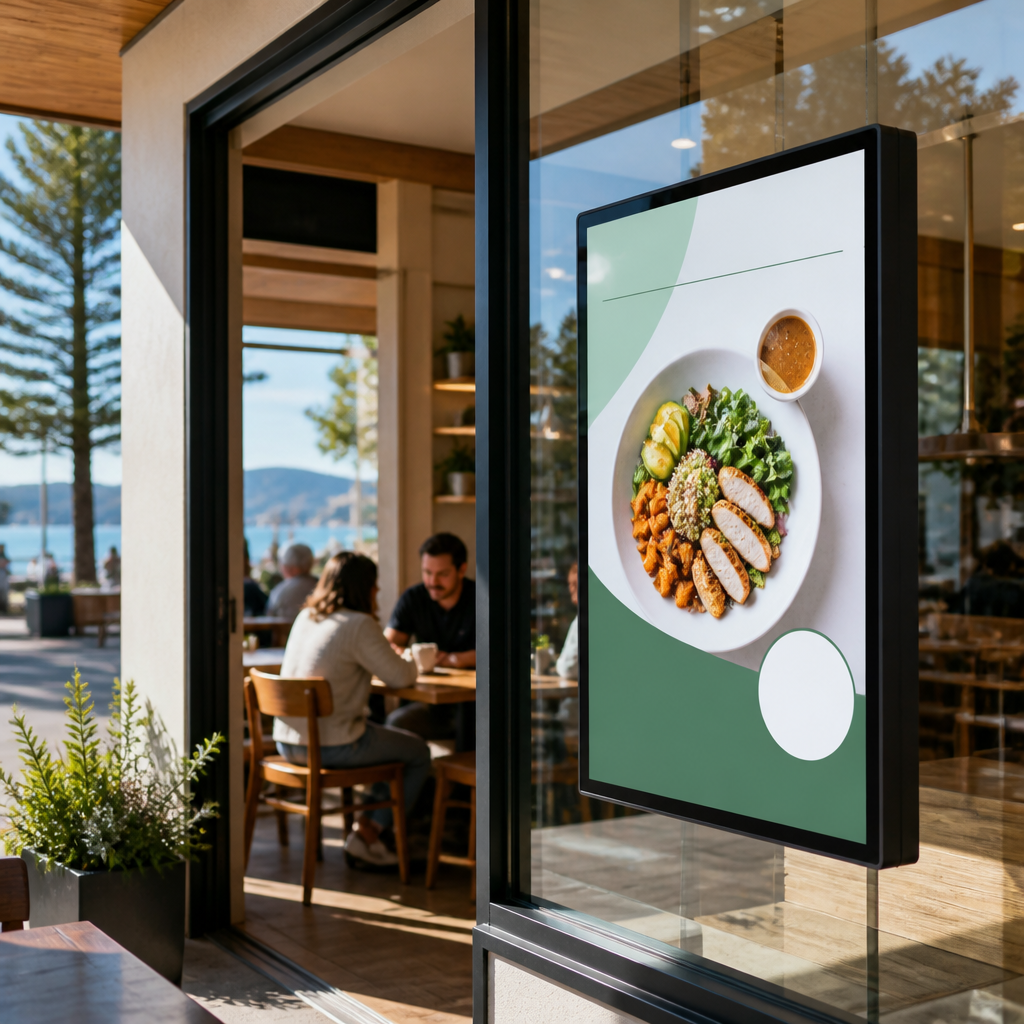
Hospitality is a footfall business, and the front window is where footfall turns into a decision. A passer-by who glances at a clear, bright offer and then sees a few tables occupied will usually walk in. A passer-by who sees a dim, cluttered window will keep walking, even if the coffee is far better.
In practice, the biggest gains come from fixing the windows that already exist, not from adding more signs. A screen placed where a tired A4 page used to sit does more work than a second screen hung in a corner nobody can see from the street.
Why static signage stops working
A printed A3 special taped inside the glass looks the same on day thirty as it did on day one. Regulars stop reading it, and new passers-by assume it is old. A screen that rotates two or three frames makes the offer visible again without a reprint, and that alone is why many owners switch.
Printed signs also fade in sun. The colour shifts on the side of the building that gets the most light, which is often the side facing the street.
Filling the afternoon gap
Most cafés are busy in the morning and lunch period, then sit at half capacity from mid-afternoon until the dinner trade starts. Window content aimed at that gap, such as a “Flat white and slice of cake, two to four pm” frame, targets people who are already in the area but have not decided where to go. The lunch rush takes care of itself, so the screen should work the quiet hours.
What a Window Screen Needs to Survive NZ Sunlight
Most indoor displays are built to sit behind a wall, not to fight direct light through glass. Put one in a shopfront that gets strong afternoon sun and the picture washes out, and the screen becomes a dark rectangle that nobody reads. The first question to ask any supplier is how bright the screen is, and whether that figure was measured.
A figure of around 700 nits is commonly quoted as the level at which a screen stays readable in direct sun. Treat that as a starting benchmark, not a guarantee, because a screen’s real performance depends on the glass, the angle and the time of day the sun hits the shopfront.
Brightness that beats glare
Brightness is only half of the problem. Anti-glare treatment and the contrast of the content matter as much, because a bright screen with pale text on a white background still disappears in sun. Use dark backgrounds with large, high-contrast text for the offer and the price.
Sunlight-readable screens are the right choice for any window that takes direct afternoon sun. Indoor screens are fine for a shopfront that faces away from the street or sits deep inside a tiled interior.
UV and weather exposure
Screens in a window are exposed to UV all day, every day, and the damage builds slowly. A UV-protected LCD screen costs more upfront, but it avoids the yellowing and premature failure that show up after a summer on a sunny street. Ask for the protection specification in writing before you sign.
Hanging cable versus wall mount
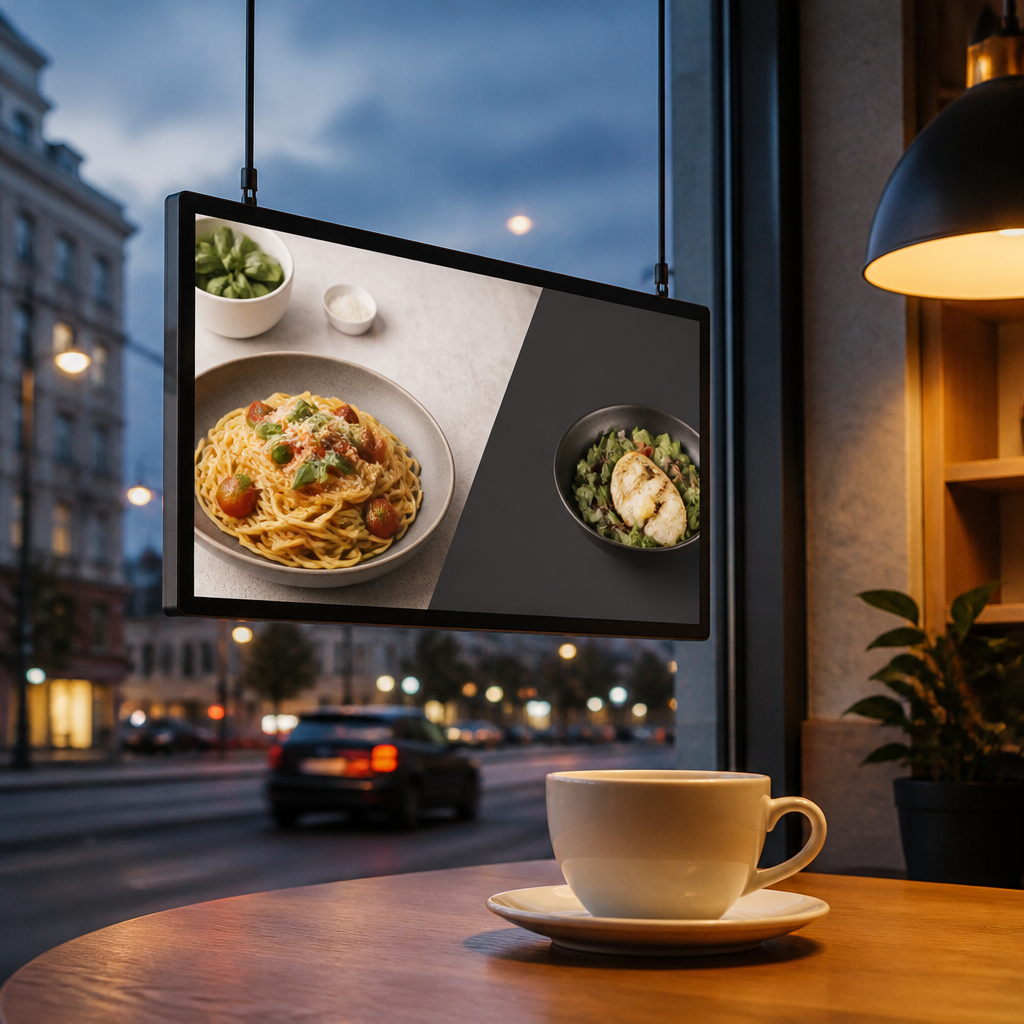
Hanging cable LCD displays suit narrow windows, glass frames that cannot take a mounted bracket, and shopfronts where the screen needs to sit slightly in front of the glass. Wall-mounted screens give a cleaner look and suit deeper windows. In either case, plan where the power and network connection will run before the install date, because a cable run through a heritage frame can add a day of labour.
Pro tip: Ask the supplier to demonstrate the screen on your actual window at the time of day the sun hits it. A demo in a showroom tells you almost nothing about a west-facing café window in the afternoon.
Content That Fills Tables, Not Just Screens
Hardware gets the attention, but content decides whether the screen fills seats. A café that loops a generic brand film and a drink photo is paying for a screen that does nothing. The frames that work are specific, short and tied to a decision the passer-by can make in the next minute.
Each frame should carry one message. A lunch special with a clear price, a dessert deal with a time limit, and a notice that the next batch of bread is out of the oven will each do more than a mixed collage.
Lunch specials that read at walking pace
A passer-by walking past a window has a few seconds to take in a frame. Put the dish name in the largest text, then the price, then a single supporting line such as “ready in ten minutes”. Long ingredient lists belong on the printed menu inside the door, not on the glass.
Coffee and cake for the quiet hours
Afternoon frames work best when they give a reason to come in now. A time-bound offer like “Two coffees for the price of one until four” converts better than a general promotion, because it asks for a decision before the window closes. Set the playlist so this frame runs only between the hours it is valid for.
Keeping content fresh without a designer
Most café teams do not have a designer on staff, and they should not need one for a daily special. Build three or four templates with your logo, fonts and colour palette, then swap only the item name, price and image. The screen stays on brand and the owner stays in control of what goes up.
Menu Updates and Multi-Site Control
A printed menu board costs time every time the menu changes. A window screen run through remote content management can be updated from a phone in the kitchen, which means a price change or a sold-out dish is reflected on the glass within minutes. That speed matters most when the day’s specials change at short notice.
Changing a price without a reprint
Remote updates over WiFi let an owner change a frame at the start of service without waiting for a printer. Remember that the change is only useful if someone actually makes it. Set a daily routine, such as checking the window content before the lunch service opens, so the screen never falls behind the menu.
Scheduling by daypart
Android-based scheduling lets you set separate content for breakfast, lunch, afternoon and dinner, and have each one switch on automatically. This is the feature that most often separates a useful window screen from an expensive wallpaper. Breakfast coffee frames should not run at seven in the evening, and the dinner menu should not compete with the lunch deal at midday.
Managing several sites from one login
A hospitality group with a café in Hamilton and a restaurant in Tauranga should not need two separate processes to change its offers. Central control means one team can push a national promotion to every window while each site adds its own local special. Our software subscriptions include CRM and CMS integration, which helps when the offers also need to sync with email and social campaigns.
Measuring Whether the Screen Fills Seats
Most owners judge a window screen by how it looks and whether people mention it. Neither tells you whether the money is coming back. The only reliable test is whether the screen changes what happens at the door during the hours it is meant to work.
A window screen should be judged by the seats it fills at the hour it is meant to fill them, not by how many people glance at it.
Set a baseline before the install
Count covers, or walk-ins if you use a booking system, for the same daypart over two weeks before the screen goes live. Record the weather too, because a wet week skews every window result. Without a baseline, any increase after installation is just a guess.
Attach a unique code to each screen offer
Give each window offer its own voucher code, or ask for a specific phrase at the counter. When a customer uses it, you know the screen did the job. Rotate the codes monthly so an old offer cannot be redeemed for months after it has stopped running.
Pro tip: Run the window screen on one daypart for three weeks and leave another daypart unchanged. The difference between the two is the clearest evidence you will get without a formal study.
Watching the door at peak times
Ask staff to note how many customers mention the window offer during the first week. Those notes are rough, but they highlight which frames are being read and which are being ignored. Pull a frame that gets no mention after ten days and replace it with a clearer offer.
Comparing Window Display Options for Hospitality
Three approaches cover most café and restaurant windows in New Zealand: printed backlit paper, static LED backlit displays and digital LCD screens. Each has a different cost pattern and suits a different kind of offer. The right choice depends on how often your offers change and how much control you need over them.
| Approach | Best Suited To | Main Trade-off |
|---|---|---|
| Printed backlit paper (A3 and A4) | Small windows, steady menus, owners who want a low-cost starting point | Every change means a reprint and a manual swap, and sun fades the print over time |
| Static LED backlit display | Permanent branding that needs to be visible at night and throughout the day | The content is fixed or changed rarely, so it cannot handle daily specials |
| Digital LCD window screen (including hanging cable) | Rotating dayparts, frequent price changes and multi-site offers | Needs a power and network plan, plus a sunlight-readable spec for west or north-facing glass |
When backlit paper still wins
Premium backlit printing paper is still the right answer for some hospitality windows. A café with a steady menu, a small frontage and a tight budget can get a clean result from backlit A3 or A4 sheets, particularly when the offer changes only seasonally. Bulk paper orders also make sense for a group that wants the same look across several sites without buying screens for each one.
The mistake is choosing paper for a window that needs daily change. If you are reprinting every week, the labour and waste cost more than a screen would.
Common Mistakes That Waste a Window Screen
The most common mistake is treating the screen as a television. A full-screen menu with twelve items, a logo and a looping video is unreadable from the footpath. Passers-by see motion and clutter, and they keep walking.
Leaving expired offers on the glass
A promotion that finished last week tells customers the business is not paying attention. Set an end date on every frame, and check the playlist every Monday. If a screen goes dark for a day, that is far less damaging than a stale offer.
Mounting where the glare hits
Installing a screen in a window that takes direct sun between midday and late afternoon is one of the easiest ways to waste the spend. Check the sun path at the times you care about before choosing the screen type and its position. A small change in placement can make the difference between a readable screen and a dark panel.
Forgetting the power and network
A screen with no reliable connection cannot be updated remotely, which defeats the main reason to buy one. Confirm the WiFi signal at the exact mounting point before the install, not at the router. Plan for the power outlet and the cable route at the same time.
Frequently Asked Questions
How bright does a café window screen need to be in New Zealand?
Any window that takes direct sun needs a sunlight-readable screen, and you should ask for the brightness figure in writing. A screen rated for indoor use will wash out on a sunny street, so the spec matters more than the size. If the window is shaded or set deep inside the shopfront, a standard indoor-rated display may be enough.
Is a digital window display worth it for a small café?
It can be, provided the café changes its offers often enough to use the screen. A small café with a steady menu may get more from backlit paper, while one running daily specials or quiet-hour deals will usually get more value from a screen. Run a baseline count before you decide.
What content works best on a restaurant window screen?
Short frames with one clear offer, a large price and one reason to come in now work best. Dinner specials, time-limited deals for the quiet afternoon and a note about fresh bread or a new dish all outperform long menus. Keep each frame readable at walking pace.
Can I update the screen from my phone?
Yes, with remote content management over WiFi, you can change frames from a phone or computer without visiting the venue. Make sure the WiFi signal is strong at the mounting point before installing. A daily check at the start of service keeps the content accurate.
Which mounting option suits a narrow shopfront?
Hanging cable LCD displays are often the better choice for narrow windows or glass frames that cannot take a bracket. They also work where the screen needs to sit slightly in front of the glass. Confirm the cable route and power point before the install date.
If you run a café or restaurant and have tried a window screen, tell us in the comments which offers brought people through the door and which ones were ignored.
We would love your feedback and any insights you would share with others. What perspective would you add?